Planning for the financial future of an adult with a developmental disability can feel complicated. Families may want to save for housing, transportation, assistive technology, personal support, education, or emergencies while also protecting access to important public benefits.
An ABLE account in Virginia may help eligible individuals and their families save for disability-related expenses in a tax-advantaged account. When the account is managed according to applicable rules, the funds generally do not affect eligibility for many means-tested benefit programs.
This guide explains how ABLE accounts work, who may qualify in 2026, which expenses may be covered, and what Virginia families should consider before opening an account.
This article is provided for general educational purposes and is not legal, financial, benefits, or tax advice. Families should consult qualified professionals regarding their individual circumstances.
What Is an ABLE Account?
ABLE stands for Achieving a Better Life Experience. An ABLE account is a tax-advantaged savings account created for an eligible person with a disability.
The individual with the disability is the owner and beneficiary of the account. Family members, friends, employers, organizations, and other eligible contributors may add money to it, but the funds must be used for the beneficiary’s qualified disability expenses.
According to the Internal Revenue Service, earnings may grow tax-free, and distributions are generally tax-free when used for qualified disability expenses.
Virginia sponsors the ABLEnow program, although eligible individuals should review available programs and choose the option that fits their circumstances.
Who Qualifies for an ABLE Account in 2026?
A major eligibility change took effect on January 1, 2026. The disability must now have begun before the individual reached age 46. Previously, the disability generally needed to begin before age 26.
This change may allow many more adults with developmental disabilities, veterans, individuals with mental health conditions, and people with acquired disabilities to qualify.
Eligibility may generally be established when the individual:
- Has a disability or blindness that began before age 46; and
- Receives qualifying disability benefits through Social Security; or
- Meets applicable disability certification requirements.
A person does not necessarily need to receive SSI or Medicaid to open an ABLE account. The eligibility requirements should be reviewed directly with the selected ABLE program.
How Much Can Be Contributed in 2026?
For 2026, the standard annual ABLE contribution limit is $20,000. This limit applies to the combined contributions made by the account owner, family members, friends, and other contributors during the year.
Some employed account owners who do not participate in an employer-sponsored retirement plan may qualify to contribute additional money through the ABLE to Work provision.
According to ABLEnow’s 2026 contribution guidance, an eligible working account owner may be able to contribute up to $35,650 in total, depending on compensation and other requirements.
Contribution limits can change, so families should confirm the current amount before making financial decisions.
What Can an ABLE Account Be Used For?
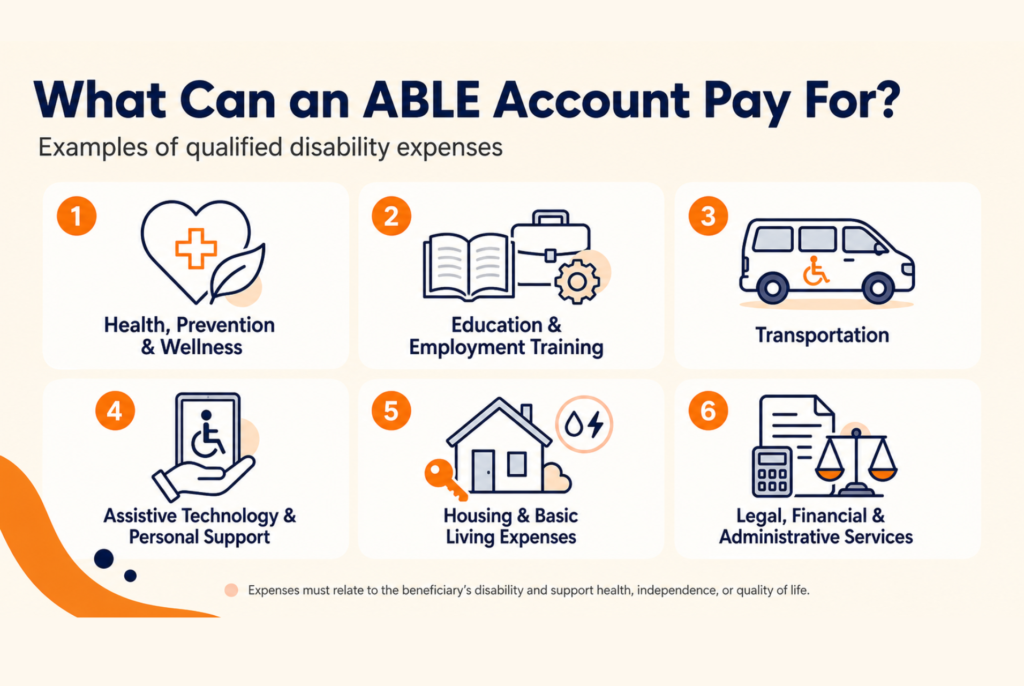
ABLE funds may be used for qualified disability expenses that help maintain or improve the beneficiary’s health, independence, or quality of life.
These expenses may include:
- Housing and eligible household expenses
- Transportation
- Education and vocational training
- Employment training and support
- Assistive technology
- Personal support services
- Healthcare, prevention, and wellness
- Financial management services
- Legal and administrative expenses
- Oversight and monitoring
- Funeral and burial expenses
The definition is intentionally broad. An expense does not always need to be medically necessary, but it must relate to the beneficiary’s disability and support their health, independence, or quality of life.
Examples for Everyday Life
Depending on the individual’s situation, ABLE funds might help pay for:
- Rent or certain housing expenses
- Accessible transportation or rides to appointments
- A computer, communication device, or adaptive equipment
- Job training or employment-related support
- Education and skill-development programs
- Personal support services
- Health and wellness expenses
Families should keep receipts and clear records showing how distributions were used. Housing distributions may also have special SSI timing rules, making careful planning particularly important.
How Does an ABLE Account Affect SSI?
One of the most important ABLE account benefits is its treatment under Supplemental Security Income resource rules.
The Social Security Administration generally excludes the first $100,000 in an ABLE account when calculating the beneficiary’s countable resources for SSI.
If the balance exceeds $100,000 and causes the beneficiary to exceed the applicable SSI resource limit, SSI payments may be suspended until countable resources return to an allowable level.
Medicaid may continue during an SSI suspension caused specifically by an ABLE balance over $100,000, provided the individual remains otherwise eligible. Different consequences may apply when non-ABLE resources cause the person to exceed benefit limits.
Because benefit rules depend on the person’s complete financial circumstances, families should speak with a qualified benefits specialist before moving or withdrawing substantial amounts.
Virginia Tax Advantages
Virginia provides an additional potential advantage for contributions to a Virginia-sponsored ABLE account.
According to the Virginia Department of Taxation, qualifying contributions to an ABLEnow account may be eligible for a Virginia income tax deduction of up to $2,000 per contributor, per account, each year.
Amounts exceeding the annual deduction may generally be carried forward to future tax years. Different rules may apply to contributors age 70 or older.
Families should consult a tax professional to determine whether they qualify and how the deduction should be reported.
ABLE Account vs. Special Needs Trust
An ABLE account and a special needs trust can both be part of long-term financial planning, but they are not identical.
ABLE Account
- Owned by the individual with the disability
- Can provide greater control over everyday spending
- Has annual contribution limits
- Must be used for qualified disability expenses
- May include a checking or investment option
- Can support self-determination and financial independence
Special Needs Trust
- Is managed by a trustee
- May hold inheritances or larger amounts
- Requires legal preparation and administration
- Has its own distribution and public-benefit rules
- May be appropriate for more complex estate planning
Families do not always need to choose one or the other. In some circumstances, an ABLE account and a properly prepared special needs trust can work together.
An attorney experienced in disability and special needs planning can explain which structure may be appropriate.
How ABLE Accounts Can Support Independence

Financial independence is not simply about having money. It also involves making choices, understanding priorities, planning for expenses, and receiving support without losing personal control.
An ABLE account can become part of a broader person-centered plan by helping the individual:
- Identify meaningful savings goals
- Participate in budgeting decisions
- Prepare for housing and transportation expenses
- Choose technology or support that increases independence
- Build confidence managing everyday purchases
- Plan for emergencies and future needs
The level of involvement should reflect the individual’s abilities, communication preferences, and desired support. Even when another person assists with account management, the beneficiary’s goals and preferences should remain central.
A Family Checklist Before Opening an Account
- Confirm eligibility. Determine whether the disability began before age 46 and review the program’s documentation requirements.
- Review public benefits. Identify SSI, Medicaid, SNAP, housing assistance, or other benefits that could be affected by financial decisions.
- Define the savings goals. Consider housing, transportation, technology, education, employment, wellness, and personal support.
- Compare account options. Review fees, checking features, investment choices, contribution methods, and accessibility.
- Decide who will assist. Establish how the beneficiary, family, authorized representative, and financial professionals will participate.
- Create a recordkeeping process. Save statements, receipts, invoices, and documentation for distributions.
- Review the plan regularly. Update goals when the person’s housing, employment, health, or support needs change.
Connecting Financial Planning With Disability Services
An ABLE account is a financial tool, not a disability service. However, financial and support planning often influence one another.
For example, a family exploring independent housing may need to consider rent, transportation, personal support, groceries, assistive technology, and community access. A coordinated plan helps families understand which expenses may be covered by benefits, waiver-funded services, personal income, or ABLE savings.
Supported Living Services at Smiles Like Yours help eligible adults live independently or semi-independently while receiving personalized assistance with daily routines, transportation, groceries, medication, and community participation.
Families can also explore the complete range of Smiles Like Yours services, including Adult Day Support, Community Engagement, Group Home Services, Housing Guide, and Community Guide.
Smiles Like Yours does not provide financial, legal, tax, or benefits advice. Our team can help families understand the support services we provide and how those services may fit into the individual’s broader plan.
Frequently Asked Questions
Does someone need to receive SSI to open an ABLE account?
No. Receiving SSI or another public benefit is not necessarily required. The individual must meet the applicable ABLE eligibility requirements.
Can family members contribute?
Yes. The beneficiary, family members, friends, employers, organizations, and other eligible contributors may add money, subject to the combined annual contribution limit.
Can an adult with a disability work and have an ABLE account?
Yes. Employment does not automatically prevent someone from owning an ABLE account. Some employed account owners may also qualify for additional contributions through ABLE to Work.
Can ABLE funds be used for housing?
Housing may qualify as a disability expense, but SSI recipients should understand the special rules governing housing distributions and when the money must be spent.
Can someone have more than one ABLE account?
An eligible individual is generally limited to one ABLE account at a time, although program-to-program transfers and rollovers may be available.
Does an ABLE account replace a special needs trust?
Not necessarily. The two tools serve different purposes and may sometimes be used together. Families should seek legal and financial guidance for long-term planning.
Take the Next Step With Confidence
An ABLE account in Virginia can give eligible adults with developmental disabilities and their families another way to prepare for housing, transportation, personal support, technology, education, and other meaningful goals.
The best plan begins with accurate information and the individual’s voice. Confirm eligibility, understand benefit rules, define clear goals, and work with qualified professionals before making major financial decisions.
If your family is also exploring adult day support, community engagement, group home services, or supported living in Central Virginia, contact Smiles Like Yours or visit our Get Started page. Our team is ready to answer questions about our programs and help you identify an appropriate next step.